Midterm 1
CS2604 : Data Structures
and File Processing
Summer Session II 1999 : Midterm 1
Question One [20]
Why do we study advanced data structures ? [5]
Efficiency and generalization
What does it mean when we say that "f(n) is in O(g(n))" ? [5]
There exists a c and n0 such that f(n) <= c g(n) for all n > n0
Why do we use a dummy head node in a linked list ? [5]
To avoid having to write special coding cases to handle trivial (eg.
empty) lists
In a singly linked list, why is it more efficient to use a
"current" pointer that points to the node before the current node
? [5]
So that operations that need relinking to be performed on the previous
node can find it without an O(n) search from the head.
Question Two [20]
Match the following terms with the most appropriate
descriptions :
queue, parent, doubly linked list, stack, average case, worst case, data
structure, right child, singly linked list, freelist
| data structure | implementation |
| single linked list | one pointer per node |
| stack | elements are added/removed at one end of the data
structure |
| queue | FIFO (first-in-first-out) |
| right child | 2r+2 |
| doubly linked list | ability to always find previous node
in O(1) time |
| parent | (r-1)/2 |
| worst case | crucial for real-time
applications |
| freelist | avoid unnecessary allocation/deallocation of
storage |
| average case | consider all input
combinations |
Question Three [40]
What is a stack ? [4]
An abstract data type where the first element added is the last removed
(FILO).
What are the specific names of the 3 primitive abstract operations
associated with a stack ? [6]
(a) Push, (b) Pop, (c) Top
What is the asymptotic time complexity (in the average case) for each of
these operations, when the stack is implemented efficiently using a linked
dynamic data structure, as compared to when the stack is implemented
efficiently using an array ? [6]
|
Operation |
T(n) for array |
T(n) for linked list |
|
(a) Push |
O(1) |
O(1) |
|
(b) Pop |
O(1) |
O(1) |
|
(c) Top |
O(1) |
O(1) |
Fill in the code to REMOVE an element from the top of the stack, and
return it to the calling routine, in a linked list implementation. [14]
Node *Stack::Remove ()
{
   if (TopOfStack == NULL) return NULL;
   Node *Temp = TopOfStack;
   TopOfStack = TopOfStack->Next;
   return Temp;
}
with the following definitions :
class Node {
   char aValue;
   Node *Next;
};

class Stack {
   Node *TopOfStack;
   Stack () { TopOfStack = NULL; }
   Node *Remove ();
   .
   .
};
Assume that TopOfStack points to the topmost element and that there is no
dummy head node.
Explain how you would use a stack to check if the parentheses in a
string or expression are properly balanced. In a balanced string, when
scanning from left to right, you will never have encountered more right
parentheses than left parentheses. For example, "(())()" is
balanced while "()))" is not. Two errors are possible – either
there are too many left parentheses (e.g. "(()" ) or too many
right parentheses (e.g. "())" ) – indicate how each of these can
be checked for. [10]
Scan string L->R
- on ( push onto stack
- on ) pop from stack
- if stack is empty then "too many )s"
After scanning, if stack is not empty then "too many (s"
Question Four [20]
Consider the following tree:
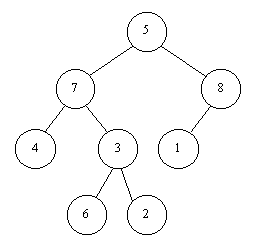
- Write out the order in which elements are visited if a PostOrder
traversal is performed on the tree. [5] 4, 6, 2, 3, 7, 1, 8, 5
- Write out the order in which elements are visited if an InOrder
traversal is performed on the tree. [5] 4, 7, 6, 3, 2, 5, 1, 8
- Approximately how many nodes in a full tree (where the tree has n nodes)
are leaf nodes ? [2] n/2
- Answer the following questions [8] :
what are the parents of "6" : 3
what are the children of "4" : none
what are the ancestors of "3" : 5, 7
what are the descendents of "7" : 4, 3, 6, 2
20 July
Last updated : 21 July 1999 11:45pm